

| 55 people took the stage Public and private sector speakers from across the EU and beyond | 100+ organisations In the three eFTI projects, from 23 countries | 9 JUL 2027 EU acceptance milestone Authorities must accept compliant eFTI information |
The main message
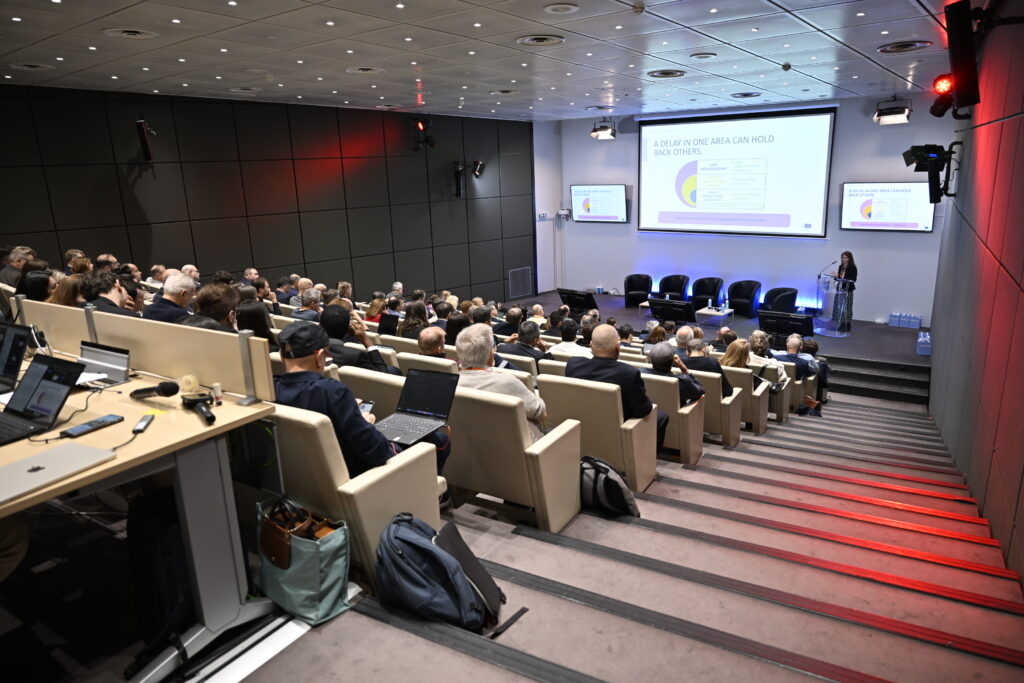
With 55 people taking the stage from the public and private sectors across the EU, a shared message emerged: Europe is moving from building the eFTI framework to putting it into practice. The central challenge is no longer just to connect national Gates and platforms: it is to make the information useful during actual checks, win economic operators over, and ensure that the ecosystem remains reliable after go-live.
Five takeaways from the two days
› A functioning Gate is not the same as a ready country. Authorities also need connected systems, trained officers, tested workflows and incident procedures.
› Voluntary business adoption must pay off. Less data re-entry, fewer roadside delays, faster invoicing and better data quality are stronger arguments than compliance alone.
› Test before scaling. Cross-border roadside checks, multi-shipment searches and “no response” cases expose problems that desk-based design misses.
› Common data, not identical software. Harmonised XSDs, the eFTI data model and Gate–platform interfaces should let independently built systems interoperate.
› Think beyond 2027. Reuse of source data for eCMR, B2B exchange, invoicing, maritime reporting and other services could make eFTI more valuable.
Why the next months matter
The immediate bottlenecks Certification rules and assessment capacity; first certified platforms; operational enforcement procedures; harmonised specifications and version management.
Readiness signal In the Commission presentation, around 22 of 27 Member States were reported as expecting their Gates to be operational before July 2027. This is a projection of Gate readiness, not a guarantee of end-to-end operational readiness.
1 | Make authorities ready to use eFTI
The question has shifted from “Can the system receive data?” to “Can the officer obtain the right information and act on it?”
What readiness looks like on the ground
• A competent authority can search by the available identifier, retrieve the relevant transport data and understand its source.
• Inspectors know how to handle several shipments and mixed formats, including eFTI data, eCMR and paper documents.
• There are clear fallback and escalation procedures if the platform, Gate or inspection app does not respond.
• Officers and drivers know what to do, including how QR codes or human-readable information can be presented when needed.
• Responsibilities for incidents, changes, versions and cross-border support are agreed, rather than left to ad hoc arrangements.
Country examples shared at the conference
| France | Several cross-border Gate tests; three platforms connected for testing; open-source reference implementation; further work on cabotage and other modes. |
| Portugal | Pilots including a real roadside check with Italy; developing the national Gate and exploring links with its Single Window and additional transport modes. |
| Nordics | Sweden, Norway, Finland and Denmark working on a joint Gate approach, with practical scenario exercises to understand what each authority needs. |
| Estonia / Malta | Estonia reported Gate testing under way; Malta was preparing a Gate tender and working on authority and driver engagement. |
| Spain | DeCA, mandatory for specified national road transport operations from 5 October 2026, uses QR-accessible PDFs; eFTI will require authority acceptance of structured data from 9 July 2027. |
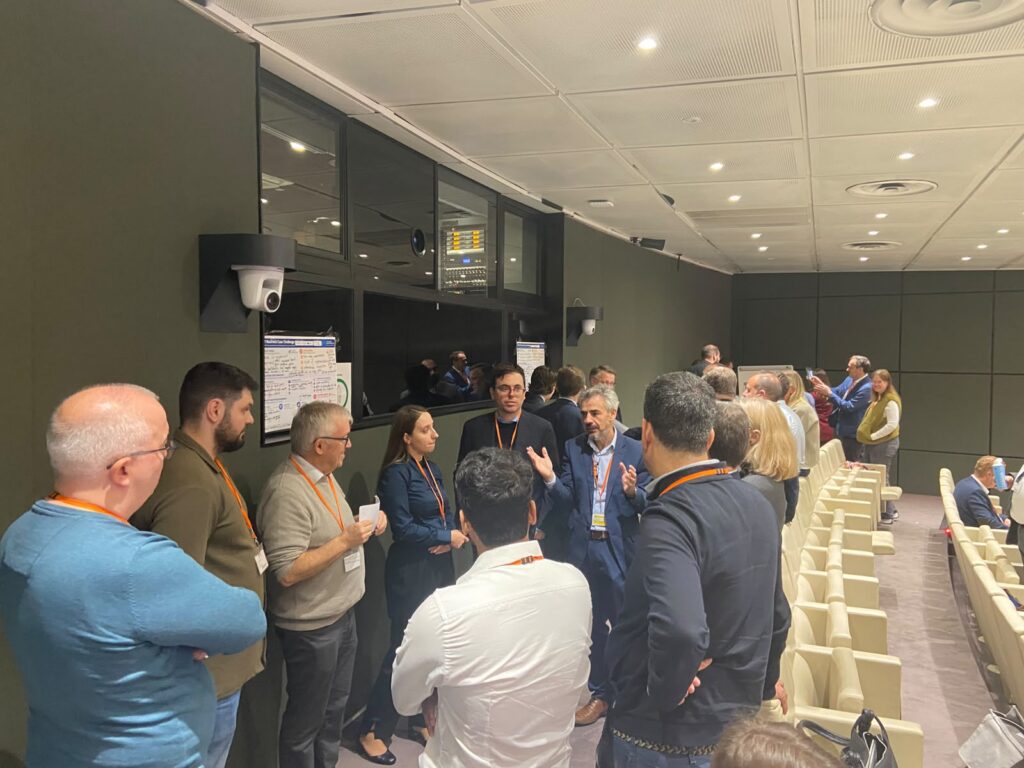
What the cross-border authority workshop revealed
Three scenarios were tested in groups:
› A vehicle is checked in a transit country; the officer searches using the licence plate.
› One truck carries four shipments across eFTI, eCMR and paper formats.
› The officer requests eFTI data but receives no response.
Practical follow-up: train both officers and private operators, define retrieval and fallback procedures, locate faults (Gate, platform or inspection app), and notify the responsible parties when failures recur. Workshop suggestions are not automatically binding enforcement rules.
Technical and governance work that enables this
Data model & interfaces The shared implementation scope begins with 183 data subsets. Harmonised XSD messages, common search behaviour and consistent Gate–platform interfaces are needed to avoid 27 disconnected ecosystems.
Lifecycle governance Define incident ownership, IT change management, version updates, knowledge management and long-term coordination across Member States and providers.

2 | Give businesses a reason to adopt
The economic-operator roundtable and workshops reached a consistent conclusion: regulatory compliance alone is not a convincing business case.
Turn the value proposition into measurable outcomes
| Less manual work | Reuse source information rather than re-entering it into separate documents and systems; improve accuracy across partners. |
| Quicker operations | Explore faster roadside checks and easier access to regulatory information; measure actual waiting time and exceptions. |
| Faster cash flow | Link timely, reliable transport data with completion evidence and invoicing; test whether digital workflows shorten payment cycles. |
| Access for SMEs | Use platforms and services that minimise the need for a small carrier to build or operate its own IT infrastructure. |
| Better integration | Bring eFTI into existing TMS/ERP workflows rather than treating it as another standalone document portal. |
eCMR, eFTI and source-data reuse
• eCMR supports electronic consignment notes and contractual relationships; eFTI supports structured regulatory data sharing with authorities. They are complementary, not interchangeable.
• Common eCMR exchange standards and definitions remain a challenge (for example, acceptance/delivery versus loading/unloading locations).
• A TMS or ERP can be the common source for eCMR, eFTI and potentially other B2B/B2A services. This wider reuse is an opportunity, not an agreed future mandate.
• The Open Logistics Foundation described freely available, open eCMR standards; the goal is interoperable solutions without vendor lock-in.
Where existing rules and systems complicate reuse
Combined transport UIRR showed that outdated documentation and stamp requirements under the Combined Transport Directive are difficult to apply even on paper. It called for practical evidence rules and clarity on who supplies information. A CMR+CIM demonstrator with Codognotto is planned.
Dangerous goods and waste Workshop participants raised offline access, emergency-service needs, data exchange with DIWASS and the difficulty of providing some shipment details in advance.
Maritime reporting Maritime Single Window and eFTI may require overlapping information. Testing must establish which data can be reused and where the systems remain distinct.
3 | What was demonstrated—and what comes next
Demonstrations and live-use cases
• IN Groupe + Pionira: a cross-border truck scenario (Antwerp–Dourges–Paris–Madrid) with two eCMRs and one digital roadside check; a practical view for drivers, operators and officers.
• Portugal–Italy: experience from testing eFTI information in a real roadside-check setting; Portugal also presented a control demonstration.
• Latvia–Estonia: cross-border testing presented as a real eFTI business case.
• Workshops: TMS integration demonstration, authority control scenarios, dangerous goods and waste, maritime interoperability and economic-operator engagement.
Unresolved issues to manage openly
› Certification availability and cost. The market needs workable certification arrangements, assessors and early platform supply.
› End-to-end accountability. Who investigates failed queries, corrects inaccurate data and coordinates across borders?
› Standards and change control. Who stewards shared data subsets, XSD versions and backwards-compatible interfaces?
› Sector-specific complexity. How should combined transport evidence, emergency access, waste data and maritime reporting connect without duplicating effort?
› Real demand. What will motivate operators to use certified solutions when participation remains voluntary?
One strategic opportunity beyond compliance
eFTI could become a common reference for broader logistics data reuse when combined with eCMR, invoicing, emissions data, Digital Product Passports and other business information. The conference framed this as potential for the future—not a defined or agreed architecture. AI-enabled coordination between platforms was also raised as a question for exploration.
The test of success: not merely whether eFTI goes live, but whether officers can use it reliably and businesses choose to use it because it works.

We would like to thank the French Ministry of Transport and IN Groupe for their hospitality and support. Our sincere thanks also go to all the speakers who contributed in person and remotely, and, last but not least, to all participants who joined us in Paris and online and helped make this an important event for the eFTI community.








© Damien Valente – Terra